
Converter

AI Face Search | Find Faces Instantly

AI Face Search

Find faces with artificial intelligence

Search Faces with AI

Upload an image or provide a URL to find similar faces in our database. Our AI-powered search can match faces across millions of images.

Supported formats: JPG, PNG, WebP (max 10MB)

Drag & Drop Your Image

or click to browse files

Search Filters

Search Results

0 faces found

Upload an image to search for matching faces

Tips for Better Results

Good Lighting

Ensure the face is well-lit without harsh shadows

Front-Facing

Front-facing portraits yield the best match results

High Resolution

Higher resolution images improve matching accuracy
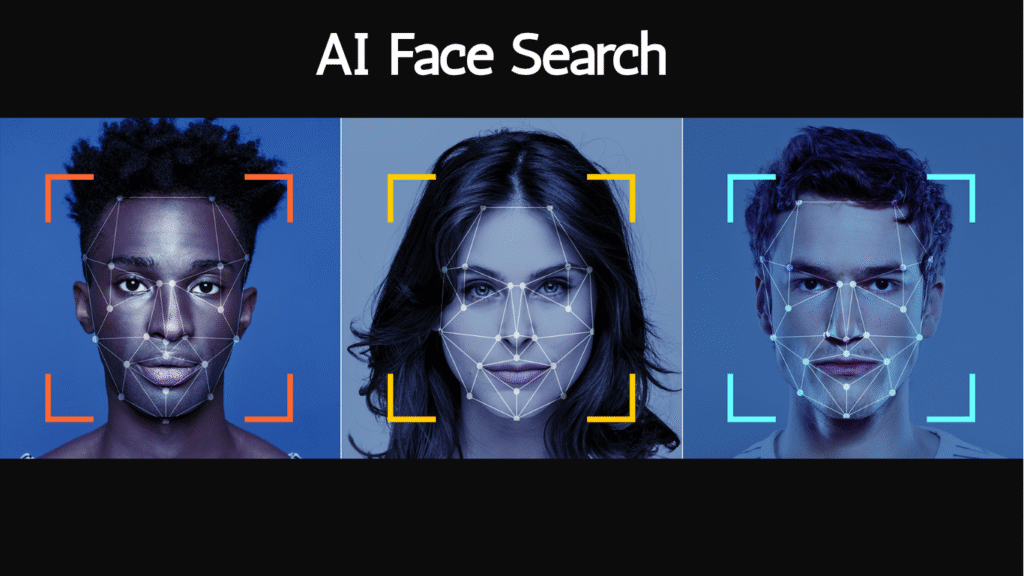
AI Face Search

Advanced facial recognition technology to search and match faces across extensive image databases.

© 2023 AI Face Search. All rights reserved. This is a demo interface for educational purposes.

AI Face Search: In-Depth Guide to Facial Recognition Technology, Algorithms, Use Cases, and Future Trends

Introduction

AI Face Search is one of the most powerful applications of artificial intelligence, combining computer vision, deep learning, and biometric analysis to identify and match human faces across images and videos. Unlike traditional image search systems that rely on metadata or keywords, AI face search focuses on biological uniqueness, making it a cornerstone technology in security, digital identity, and visual intelligence.

As global data creation accelerates and image-based content dominates the internet, AI-driven face search has become essential for accurate identification, automation, and fraud prevention.

What Exactly Is AI Face Search?

AI Face Search is a subset of facial recognition technology that allows users to:

  • Upload an image of a face

  • Analyze facial landmarks using AI models

  • Convert facial features into numerical vectors

  • Search for matches in a database or across the web

This technology does not rely on names, tags, or captions. Instead, it understands the geometry and structure of a human face.

Core Technologies Behind AI Face Search

1. Computer Vision

Computer vision enables machines to interpret visual data. In face search, it helps detect faces within complex backgrounds, videos, or crowds.

2. Deep Learning

Deep learning models—especially Convolutional Neural Networks (CNNs)—learn patterns from millions of facial images to identify unique features.

3. Neural Networks

Advanced architectures like ResNet, FaceNet, ArcFace, and VGG-Face power modern AI face search engines.

4. Biometric Mapping

Each face is mapped into a biometric signature, which is mathematically unique.

How AI Face Search Works (Technical Breakdown)

Step 1: Face Detection

The AI first locates a face using algorithms like:

  • Haar Cascades

  • MTCNN (Multi-task Cascaded Neural Networks)

  • YOLO-based face detectors

Step 2: Facial Landmark Detection

Key facial points are identified:

  • Eye corners

  • Nose bridge

  • Mouth edges

  • Jawline

  • Forehead contours

Step 3: Feature Extraction

Using deep neural networks, the system extracts high-dimensional facial features such as:

  • Bone structure

  • Facial symmetry

  • Relative distance between landmarks

Step 4: Face Encoding

The extracted data is converted into a 128D–512D vector (face embedding).
This vector acts like a digital fingerprint.

Step 5: Similarity Matching

The face embedding is compared against a database using:

  • Cosine similarity

  • Euclidean distance

  • Manhattan distance

Accuracy Metrics in AI Face Search

AI face search performance is measured using:

  • False Acceptance Rate (FAR)

  • False Rejection Rate (FRR)

  • Precision and Recall

  • ROC Curve (Receiver Operating Characteristic)

AI Face Search vs Facial Recognition

Aspect AI Face Search Facial Recognition
Purpose Finding faces Identifying identity
Output Similar images Verified person
Use Case Reverse search Authentication
Database Open or web-based Closed/private

Real-World Applications (Detailed)

1. Law Enforcement & Public Safety

  • Criminal identification

  • Missing persons search

  • Crowd surveillance

  • Border control


2. Cybersecurity & Fraud Detection

  • Fake profile detection

  • Identity theft prevention

  • Deepfake identification

3. Social Media & Content Moderation

  • Duplicate account detection

  • Image authenticity checks

  • Automated tagging

4. Banking & Fintech (KYC)

  • Face-based onboarding

  • Liveness detection

  • Fraud-resistant verification

5. Photo & Media Management

  • Automatic face grouping

  • Smart photo albums

  • Media asset organization

Ethical, Legal, and Privacy Challenges

Privacy Risks

  • Unauthorized facial scanning

  • Mass surveillance

  • Data misuse

Bias in AI Models

  • Racial bias

  • Gender bias

  • Age-based inaccuracies

Legal Restrictions

  • GDPR (EU)

  • CCPA (California)

  • India’s DPDP Act

Responsible AI face search tools must ensure:

  • Consent-based usage

  • Temporary image processing

  • No permanent storage

AI Face Search and Deepfake Detection

Modern AI face search systems can:

  • Detect face manipulation

  • Identify AI-generated faces

  • Compare real vs synthetic features

This makes AI face search a critical defense against misinformation.

Future of AI Face Search Technology

Emerging Trends

  • 3D facial recognition

  • Emotion and intent analysis

  • Cross-age face matching

  • Bias-free AI models

  • Federated learning for privacy

  •  

Integration with Other AI Systems

  • Blockchain-based identity

  • Metaverse avatars

  • Smart city surveillance

Best Practices for Using AI Face Search

  • Use clear, front-facing images

  • Avoid unauthorized searches

  • Choose GDPR-compliant tools

  • Verify results manually for critical decisions

Conclusion

  • AI Face Search represents a major leap in visual intelligence and biometric technology. By combining deep learning, computer vision, and advanced facial analysis, it enables fast, accurate, and scalable face identification across massive datasets. However, its power demands ethical responsibility, legal compliance, and transparency.

    As AI continues to evolve, AI face search will remain a foundational technology shaping the future of digital identity, security, and online trust.

Scroll to Top